Showing posts with label social studies. Show all posts

March 30, 2010

Plastic Bottles? Yeah Right

In class, Mr. Hughes was talking to us about the Kontiki, a boat designed by Norweigian Knut Haugland, who believed that people living in the primitive age could travel across bodies of water on rafts, and therefore tested this theory by sailing his boat across the Pacific.Then a few other people got an idea.

This is no joke. The Plastiki, designed by adventure ecologist David de Rothschild, is a boat made mainly out of 12,000 gas-filled recycled plastic bottles. That might sound dumb (it did to me, until I heard what kinds of stuff they have on), but check out the high-tech gear they have on this baby:
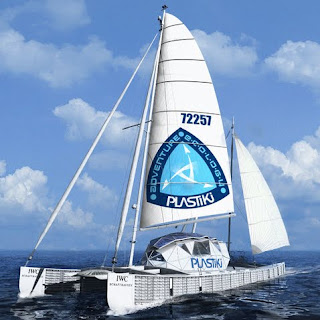
- solar panels
- pinwheels

- bicycle for extra power
- hydroponic veggie garden

The crew includes:
- Jo Royle, Skipper
- Mathew Gray, Coodinator
- David de Rothschild, Founder

They will be sailing together from San Fransisco, California to Sydney, Australia. But that isn't their goal. Their goal is to renew the awareness of plastic waste being dumped into the oceans, something that has been a problem for years but has slowly slipped from our attention. If you would like to see more about the Plastiki, visit:

January 26, 2010

Why Is Haiti So Poor? - Haiti History

1) Haiti has been a big victim of hurricanes since 2008.
2) 80% of the population is living in poverty.
3) Two thirds of the population is living off substience farming are vulnerable to tropical storms that ruin their crops and erode the land
4) Most of the population works in the farming division.
5) Not a lot of industries are found around Haiti, so to make money, most citizens have to sell old clothes, soap, and pencils
6) In the 17th and 18th centuries, Haiti was one of the richest countries in the world.
7) Haiti doesn't trade with other polity outside the country a lot.
8) There isn't a lot of coherent cash crop in Haiti since the plantations were separated into individual land parcels.
9) Haiti has a considerable lack of human natural resources.
10) The Haitian population doesn't have gread industry skills, therefore, Haiti wasn't allowed to trade with the rest of the world.

January 18, 2010

Haiti Disaster 2


There is no other word for it: Chaos. Thousands of Haitian's are being dug up from meters of concrete near broken buildings. Orphans are being sent to the US for better protection because no one can protect them with the crisis around them. US troops are doing the best to provide healthcare, but wounded citizens are dying right before their eyes: "It is a if living in a nightmare." 


Many Red Cross workers state "It it a very tough situation. Thousands of Haitian's on the streets need care immediately or they will die of bacterial infection or major blood loss. There are over 20,000 people waiting for food, water, and medication. I hope with all my heart that we will be able to help them, but so little time." 


Haitian orphan's are being relocated to the US and Canada as a result of the earthquake. Many websites; such as Youtube, Freerice, and other charity sites, have been raising money for Haiti from the number of views the site or video receives. Many new families are extremely happy together, mainly because the orphans were toddlers and don't remember their parents very well.


Haiti is holding together with our help, but for how long?? 

January 14, 2010

Haiti Disaster 1


On January 12, 2010 Haiti was directly above the epicenter of an earthquake measuring 7.0 on the richter scale. Most news stations report that 100,000 people were killed, but they aren't certain. As you can see in the picture above, a lot of injured people have been carried away in the beds of trucks. A lot Haitian's say "It feels like the end of the world." It's a really sad thing to think about because most of the population lives on $2 dollars a day, so I don't think that they can see a good doctor. The Red Cross has been hard at work though. About 1,000,000 people have been helped by them. I hope with all my heart that the Haitian's will have a better future. But we still have a lot to go through before then.

November 26, 2009

Bintaro Lama Video

We went to the Bintaro Lama Kampung on November 12 and we learned how to make their water more potable. Enjoy!!

November 23, 2009

Water Questions 2

1) List the main reasons for water scarcity.
Because variations in climate, land degradation, population growth and water pollution

2) What is a drought? What type of hardships do you think that a drought could cause if you were living in a village in a poor country such as Ethiopia?
A drought is a period of time when no rain falls. Some hardships could occur could be shortage of food (because we need rain to make the crops grow) human death, animal death, and ecosystem reduction.

3) How does land degradation affect the supply of fresh water?
Land degradation can affect the supply of fresh water because when land is paved over, the water doesn't sink in, it runs off the cement. Then there is no way to collect it.

4) What is El Nino? Why does El Nino often cause drought in Australia?
El Nino in a heating of the ocean that happens every 3-5 years in the Pacific Ocean off the coast of Peru. Warm, wet air is being blown across the Pacific off their normal course. But air pressure is built across the Pacific and brings high pressure over Australia. So Australia doesn't get a lot of moist air, and as a result, forms droughts.

5) Observe the map showing the global effects of El Nino in 1928-83
What effects does El Nino have on availability of fresh water?
Name the countries and describe the problems that arose from decreased rainfall caused by El Nino.
El Nino's effects to the fresh water supply are smaller water rations in the poorer countries, animal and human deaths, and crop reduction.
In the Philippines, a low rice harvest occurred followed by a drought. In Indonesia, the air pollution levels were high followed by forest fires. In Papua New Guinea, a severe crop failure occurred due to drought and soon after a famine struck. In China, the farming land was under threat from drought in the northern regions and flooding in the southern reasons. In Africa, there was a reduced corn crop in the sub-Saharan region.

November 18, 2009

Bintaro Lama Kampung Writing

We went to the Bintaro Lama Kampung on November 12, and we saw how the locals cleaned their water enough to make it drinkable.

We went to Station 6 first. There they added AquaTaps and Air RahMat to the water (special chlorine tablets and liquid) to make it potable. The AquaTaps are small chlorine tablets that dissolve in the water if you wait 30 minutes. 1 tablet will normally clean 10-20 liters of water (depending on the condition.) The Air RahMat is a special chlorine that acts like the AquaTaps. You add the chlorine into the water, seal the jug (make sure there is no air in it), and shake it for 30 seconds. Then you leave it to sit for 30 minutes.

Next we went to Station 2. The "Little Mosque" is where WatSan Action members come and teach the children about water hygiene and safety. They showed us the for major ways to stop disease transmission: 
1) Wash Your Hands!!
a) Use CLEAN water
        b) scrub with soap
        c) rinse with CLEAN water
        d) dry with towel
2) Make A Toilet With A Septic Tank!!
3) Cover Your Food!!
4) Use Air RahMat and AquaTaps!! After that, they sang a song in Bahasa to us about washing your hands.

Lastly, we went to Station 4. Here the WatSan Action members showed us how to filter the water. First, they added Alum to the water. Alum is a special powder that makes the dirt particles stick together. Once there were a lot of clumps, called floc, they stirred the water gently with a stick. Next, they waited until the floc settled onto the bottom of the container. After that, we watched as a WatSan Action member poured the water through a clay pot to get most of the sediment out.

Going to the Kampung was a very interesting experience. We realized that they use the same steps that they use in the Water Treatment Plant, but on a house hold scale. Going there reminded us about how lucky we are to have freshwater at our fingertips. When we are thirsty, we go and get some water without thinking about where it came from or how it got cleaned. Once you realize the time it takes, it makes a difference.

November 10, 2009

Water Questions 1

1. What percentage of the world's supply of water is fresh water?
2.5 percent is fresh water of all the water on earth.

2. Where is the world's supply of fresh water found?
2 percent in ice on land, 0.49 percent is ground water, and 0.01 is in the air, rivers, and lakes

3. Even though the supply of fresh water is abundant it is still a problem. Why?
Water is a problem because it isn't spread out evenly.

4. Observe the map of world average annual precipitation (opposite)
a) Describe the changes in rainfall that occur as you move from the southern to the northern tip of Africa.
b) Describe the changes in rainfall that occur as you move from the western to the eastern tip of Australia along the Tropic of Capricorn.
Near the bottom of Africa, it is pretty dry. As we move closer to the equator, we get more rainfall. On the equator, we get the most yet. Then as we move away, it becomes more dry.
Near the eastern coast of Australia, it is really really dry. As we move inland, it doesn't change that much. But as we approach the west coast, we get the most rain yet.

5. Observe the map above of water availability per person.
Which parts of the world appear to have a large amount of water available per person?

Which parts of the world appear to have a small amount of water per person?
 Central Africa, Northern and Central South America, Northern Europe and Asia, Northern Australia
Central and East Asia, USA, most of Europe, Northern, Western and Southern Africa

6. Observe the diagram of water use.
What are the main uses of water?
Which uses have increased the most over the last century?
Agricultural and Industrial
Agricultural

November 09, 2009

Water Transformation

Chlorine Basins

Cholera Bacteria

Water Transformation

We went to the Water Treatment Plant for a field trip last Thursday and saw the steps that the treatment plant took to transform filthy river water into drinkable “good” water. 

Under the city roads, the river churned and swished. It was brought into the plant where two big metal screens filtered out all the big pieces of trash. Sadly, not all of this trash was from nature. We observed a lot of human waste being stopped at the screens like trash bags and plastic food containers. They raised the screens and removed all of the build up every hour or so. Next came a smaller screen to catch and other pieces of trash that got through. Most but not all garbage was cleared out.

Next the water went through a machine that swirled the water around. This transferred oxygen to all parts of the water so that way it would be easier to treat.

After that, we went to a station where workers added alum to the river water. Alum is a substance that is very similar to a magnet. It is used to make dirt particles clump together. When the particles clump, it’s called floc. When most of the dirt has turned to floc, we transfer the water to a new station.

Then we moved to the sedimentation station. This station is where we let the floc settle to the bottom of the water. The water sits there in these individual compartments and sat there for a few hours. When all of the dirt has settled on the bottom, we move to the following station. 

Now we moved to the sand filters. Once the water travels through the channels, it comes into this big basin. Here we pour the water over special sand and it traps all of the remaining bits of dirt and junk. It should come out free of anything other than water.

The last step is adding chlorine and testing the water to make sure that it is free of any color and bacteria. The chlorine makes sure that the water is clear and free of any germs or diseases. But to be on the safe side, they test it very carefully to make sure it is clean enough for us to drink and use in our daily lives. 

I found this field trip to be very informational and interesting. Us humans litter all the time and don’t notice all the effort that is put into making our water clean. So now that we know, let’s keep it that way. 

November 01, 2009

Water Cycle

Evaporation
Evaporation is when water goes
out of its liquid state into water vapor.
You can almost see the water vapor
in the sun here.


Condensation
Condensation is when water vapor 
becomes cool enough to become liquid water.
In the picture, you can see that water 
has condensed on the glass.


Precipitation
Precipitation (otherwise known as rain)
is water vapor that has cooled enough 
and become heavy enough to fall from
the sky. This picture shows rain on a street.

Infiltration
Infiltration is when water sinks
into the earth. This picture shows
a garden hose spraying a plant. 
The water is soaking into the ground 
in the process.

September 03, 2009

Earthquake!!!


Animals sensed it. News stations reported it. Then we felt it. With the magnitude of 7.4, the earthquake brought death and destruction to Java.
Of course, since Indonesia is in the ring of fire, we have earthquakes almost all the time, but this one was one that the 6th grade and I think was another great example of nature in action. We had a tsunami warning because, you know, since we are so close to the coast, we would probably have a tsunami, but no. The ocean of which the earthquake was taking place was on the other side of Java, so it was very likely that we wouldn't have a tsunami. Since Jakarta is flat, we had no landslides, but as we moved deeper into the island, were the mountains were, landslide started to occur. This is an enviornment working.


But think of this now, readers. If you put people into the disasterous picture, what would happen then? I'll tell what happened. House were destroyed, inoccent lives were taken, and derbis was tossed. On that note, think about this. If we hang things from the ceiling, for whatever the reason, it could kill us! Those things could rattle and fall, then kill us! This, was what happened when we put people in the picture. This was the earthquake.

August 19, 2009

Typhoon Morakot

Taiwan was helpless as the storming waves smacked the gritty sand and silt, bringing down bridges and smashing houses. Crushing pound of mud pressed and squeezed the life out of innocent citizens. This is Typhoon Morakot.


This picture shows waves 30 feet high pummel the defensless land of Taiwan. The waves of this storm swept away cars, tossed around rubbish, and knocked down bridges and buildings. Mother Nature sure has its way of making a statment. Taiwan got 2 meters of rain this past weekend and this is what was the result of it. This, though, as shocking as it is, was a window to show us 6th graders nature in action. I think it has a connection with people and the enviornment and how nature acts and when people are in the scene, it can get messy!!